
AGRI-PHOTOVOLTAICS
AGRI-PV PLANTS

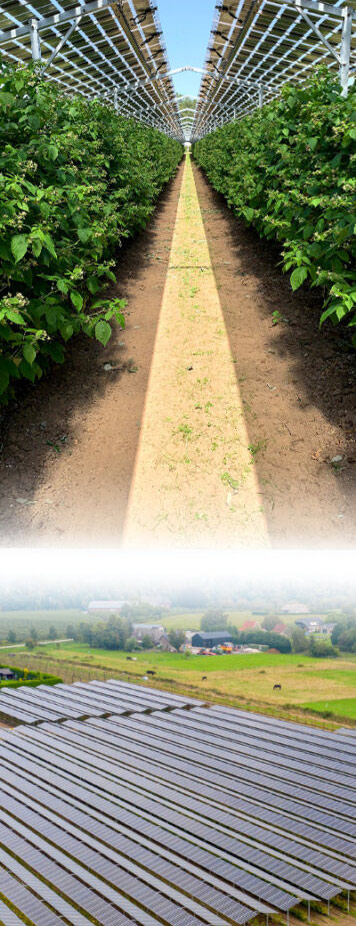
Such agri-PV systems have low electricity production costs in regions with highly developed infrastructure, meet all requirements for direct payments (excluding pseudo-agriculture), and enable efficient dual land use in vegetable, arable farming, and berry cultivation by intelligently and profitably combining partial weather protection with ecological electricity production on the same plot. The construction of an agri-PV project outside of building zones (with or without connection to the public power grid) requires a building permit and is already permitted under current spatial planning, energy, and other regulations applicable to cantonal and municipal authorities. Power generation system (PGS) that comply with zoning regulations may be site-specific outside of building zones, particularly if they provide benefits for agricultural production in less sensitive areas. Such agricultural benefits are identified in a carefully developed agricultural concept, extensively optimized, and then thoughtfully integrated into the project plant design as well as into various stages of spatial planning. This part of the plant development is the most extensive and complicated aspect of an agri-PV construction project. A consolidated building permit process therefore requires an agriculturally sound plan as well as a primary use that is beneficial to agricultural production. Issues related to the planning of agri-PV systems are typically very broad in scope and must be addressed in a highly specific manner. They range from agricultural land law to spatial development – including site-specific requirements, crop rotation areas, infill development, or intensive agricultural zones – to water protection, special-use plans (with infrastructure development), or local planning revisions, as well as environmental impact assessments and other planning requirements such as glare protection, soil, hydrological and geological reports, or soil protection concepts. The gap between developing a viable agricultural concept and creating a profitable agri-PV power generation facility remains the primary reason for the failure of agri-PV projects in the late stages of development. A qualitative crop analysis and in-depth plant design work should therefore always be a prerequisite in the early stages of a project, especially since these steps help avoid unnecessarily high development costs. Furthermore, one should not underestimate the important interdependencies and interactions between complex factors in the development of an agri-photovoltaic plant (e.g., restrictions on crop management and land-use regulations combined with the construction of such a system outside of building zones), as well as the market opportunities regarding the integration of renewable energy into the energy market that must be identified in a timely manner (Swiss target by 2050 = production of approx. 45 TWh of PV electricity). Thus, it is not only the energy transition that presents an opportunity here, but also the food transition and the associated increase in demand for locally produced specialty crops. The unique and entirely ethically grounded synergy between food production and energy generation is pivotal to the successful implementation of our energy transition. Specific synergies arising from such interconnections could therefore represent more value for customers than just a transaction. In support of this, it should be noted that it is in line with our corporate philosophy to take into account the concerns of all stakeholders throughout the development, construction, and operational phases. After several decades of operation, all high-quality plant components can be replaced or upgraded (repowering). For example, solar modules can be easily replaced from the side or from below without the use of cranes, and, like all materials and electrical components, are approximately 95% recyclable. The substructure is even fully recyclable, and since the plant foundations are constructed without concrete embankments, the plant could also be dismantled quickly should the plots be repurposed or sold.
ADVANTAGES OF AN AGRI-PV PLANT
- Generating significant additional revenue and reducing grid fees through agri-PV systems, which are characterized by low electricity generation costs and high energy production, while simultaneously making a significant contribution to the energy transition and the decarbonization of our energy sector
- Increasing land-use efficiency (without competing land use) with agronomic benefits for vegetable, arable, and berry cultivation, as well as economic benefits from environmentally friendly and cost-effective electricity generation
- Establishing a stable, environmentally friendly, and sustainable, partially covered weather protection undesirable extreme weather events (such as late spring frosts, heavy and prolonged rainfall, sunburn, heat stress, water scarcity, droughts, wind erosion, hail, and strong gusts of wind), as well as reducing labor costs related to cultivation, irrigation, and shading
- Introducing a resource-efficient crop cultivation method (reduction of water, fertilizer and pesticide consumption, lower susceptibility to wind and erosion risks, no more rain-induced splitting, less fungal infestation due to moisture and waterlogging, and increased resilience or stabilization of crop yields thanks to lower pest infestation)
- Creating a more favorable microclimate for both operational staff and crops through protected cultivation (milder microclimate in winter, cooler in summer, better planning of cultivation schedules, reduction of peak loads, optimal shading, improvement of soil and plant growth conditions, and achievement of ideal evapotranspiration and nutrient cycles)
- Operating an agri-PV system using concrete-free piling foundations with a short dismantling time and possible incorporation of smart agricultural technologies (integrated water management, plant support and decision support systems, compatible with autonomous LaserGuide guidance systems)
- Obtaining specific funding for agri-PV systems and unlocking biodiversity and marketing benefits in various markets (alternative to plastic covers)
A simple, cost-effective, and environmentally friendly solution for protecting arable crops, vegetables, berries, and specialty crops. Our agri-PV systems are completely weatherproof, require no concrete foundations, are ready for immediate use, remain stable for generations, and are characterized by very low operating costs.
WHY JBMC INC
Sustainable development from which everyone Involved can benefit and grow – in the form of an economic, ecological and social return. This is what we stand for!
For people, your livestock and our environment

developed in CH, E.U & the PRC
SYSTEMS / MODE OF OPERATION
Operating an agri-PV (APV) system not only yields agronomic benefits but also generates revenue through the production of solar power, thereby making a significant contribution to the transfor-mation of our country’s energy sector. From a technical standpoint, open-field agri-photovoltaic power generation systems can be integrated in a variety of ways on full-yield farmland and consist primarily of two types of systems: 1) grid-connected systems, 2) off-grid systems.
A grid-connected agri-PV system refers to the technical installation of elevated PV power generation systems on agricultural land (dual land use), which generate electrical energy and feed AC power into the distribution grid. Agri-photovoltaic systems consist of a solar array (pile foundations, substructures, and solar modules), central electronics (DC string harnesses and smart inverters), and power transformers (including underground conduit, high-voltage conductors, and cable trenches). In addition to the agri-PV system described above, a battery energy storage system (BESS) can be integrated, which can help stabilize Switzerland’s public power grid through peak shaving, system services, and voltage regulation. Large-scale storage systems are typically operated by energy supply companies (ESC) and should be capable of withstanding deep discharges and exhibit high cycle stability. The maximum return that can be achieved from a techno-economic perspective through the use of grid-connected large-scale storage batteries results from intelligent market optimization combined with participation in the electricity market, particularly through the utilization of price spreads across various wholesale markets, including the spot market and intraday trading. An off-grid photovoltaic system refers, as explained above, to the technical installation of elevated PV energy generation plant (EGP) on agricultural land (dual land use), which generate electrical energy and – via a storage system – feed DC or AC power into an off-grid industrial grid. Agrivoltaic systems consist of a solar array (pile foundations, substructures, and solar modules), central electronics (DC string harnesses and load break switches), battery storage systems (BESS or PtH), a power conversion station (CPCS), and the associated power distribution transformers (including underground conduit, high-voltage conductors, and cable trenches). Unlike grid-connected systems, off-grid systems operate completely independently of the public power grid and enable the off-grid operator to manage their electricity efficiently and optimize it independently and cost-effectively. The framed solar modules are all bifacial, allowing for maximum utilization of sunlight from all directions. Their efficiency is the highest possible in industrial manufacturing! The substructure – comprising the posts driven into the ground, the central tubular framework, and the various rail systems – is made of corrosion-resistant steel and/or aluminum. The entire system ensures efficient installation, long-term use, and high cost-effectiveness. EXCHANGE OF EXPERIENCE CH & EU
AGRONOMY

The aforementioned agronomic advantages (fulfilling the requirements for increased yields through shading and yield protection) are particularly evident in our efficiently designed systems, which create ideal growing conditions for vegetables, arable crops, and berries, as well as improving the crops' adaptability to adverse weather events. Pome and stone fruit crops, such as strawberries, are generally unsuitable for agri-PV systems, primarily due to high construction costs and low electricity production, as they require sunlight for their own use. The primary function of agri-PV systems is to provide stable, partially covered weather protection for agricultural crops. This protection has a positive ecological impact against severe weather events such as late spring frosts, heavy rain and prolonged rainfall, sunburn, heat stress, water scarcity, droughts, wind erosion, hail (including scattered hail), and strong gusts of wind. Secondarily, agri-PV systems serve the purpose of long-term and profitable energy production. At suitable locations and when ideally coordinated, both functions form a highly interesting synergy. Depending on the constellation of project participants, various actors and areas of responsibility with different functions are involved in the implementation. Technically well-planned agri-PV plants, especially with regard to the structural arrangement functions (system design and orientation, external loads and statics, substructures, mounting, module arrangement, land use rate, planting density, soil compaction, cultivation and management, landscape aesthetics, system parameters, etc.) as well as the crucial agronomic analysis (biocenosis and ecophysiology, plant growth modeling, light compensation and saturation point, phenotyping and shade avoidance strategies of the plants, convective air cooling and microclimate, soil quality improvement measures, biodiversity and environmental influences, etc.), enable resource-efficient cultivation in vegetable, arable farming and berry crops from an interdisciplinary and agricultural science perspective and promote biodiversity. For crop development, methods such as regenerative agriculture (strengthening soil life through minimal tillage, undersowing and organic fertilization for humus enrichment), permaculture (closed nutrient cycles, use of crop residues, mulch material and shade for moisture retention and weed suppression), precise fertilization and drip irrigation (system-integrated) as well as plant protection (mechanical weed control instead of herbicide use) are integrated to optimize microclimate, soil, water (-evaporation) and nutrients. Key measures for improved soil quality include stronger and more homogeneous direct soil irradiation (thanks to adjusted tilt angles of the PV modules and a reduction in ground cover), less year-round vegetation, humus build-up, avoidance of pesticides, use of drip irrigation, and mechanical weed control. High qualitative benefits for valuable plants and animals (including biodiversity, small animals, ground-nesting birds, soil fungi, protozoa, nematodes, arthropods, archaea, bacteria, microorganisms, and soil ecology) can always be expected in our plants. Benefits from reduced risks of water contamination (nitrate leaching and denitrification, pesticide residues [also on solar modules], drainage, slurry issues, etc.) are also present. Crops that benefit from or even require partial shading and prefer a specific microclimate are particularly suitable for protected cultivation under agrivoltaic systems. In addition to traditional arable crops (cereals, root crops, oilseeds, legumes, fiber crops, and forage crops), vegetables (cabbage, leafy greens, bulbs, flowering vegetables, tubers, and root vegetables), most herbs and spices, aggregate fruits (raspberries, blackberries, and cloudberries), true berries (red and black currants, blueberries, jostaberries, elderberries, aronia berries, and cranberries), and certain pome and stone fruits (e.g., certain apple and cherry varieties) are also ideal. In production, the aforementioned plant genera require and tolerate a certain amount of shading. This shade is optimally and homogeneously generated under a properly designed agri-photovoltaic system, thus enabling the desired yields to be maintained even under exceptionally unfavorable weather conditions (including appearance, freshness, cleanliness, ripeness, taste, nutrient content, health, and shelf life). The climatic conditions in spring, which are crucial for the growth of young plants, are undergoing fundamental changes (precipitation, uncompensable moisture deficits, early warm and cold fluctuations, direct and diffuse radiation, etc.). The combination of decreasing precipitation and increasing global solar radiation further enhances the suitability of agri-PV systems. However, robust varieties remain the recommended choice for agri-PV systems. Flowering and light management of the entire system are also two important success factors that must be considered on a case-by-case basis and always optimally coordinated during the planning of agri-PV plants. Plug-in plants and cuttings (young plants after propagation) require a specific amount of light to develop lateral buds at the desired time and to bear fruit on schedule. Flowering (the transition from the vegetative to the reproductive phase) occurs either autonomously upon reaching a certain stage of plant development (flowering maturity) or can be induced by day length (photoperiodism), and in many plants also as a reaction to stress factors (fungal or parasitic infestation). This latter method is now widely used in the propagation of, for example, various long cane raspberry varieties (autumn and summer varieties) and is primarily employed to produce healthy and vigorous plants. In addition to the aforementioned berry cultivation, agrivoltaic systems are also conceivable for pome fruit and espalier fruit orchards. Since these belong to the category of ground-based perennial crops and have proven to be somewhat sensitive in terms of light management, we consider long-term research results from existing systems desirable before constructing agri-photovoltaic plants above such growing areas. The height of the system under pome fruit trees could also be a limiting factor, as height translates to higher costs, and these costs – along with the often lower density of solar cells above pome fruit orchards – are crucial for the financial viability of such an agri-PV project. It is quite conceivable that the advantages of agri-PV systems above pome fruit and espalier fruit orchards could lie in reducing the need for frost protection irrigation and chemical thinning (fruit set). Precision farming is also becoming increasingly important in our agri-PV plants; for example, integrated water management, plant support and decision support systems, compatibility with LaserGuide guidance systems or automatic steering assistance systems, as well as autopilots, drones, and automated tractor concepts (ATC) are ideally suited for our agri-PV systems. GPS position signals and real-time kinematic corrections are replaced in our systems by laser sensor data acquisition, which is based on the system design and no longer depends on rovers, satellites, and base stations. This allows farmers to use tow vehicles and machines that can drive much more precisely and autonomously (which could mean less work) and to have an ATC that would be available at a lower cost than conventional systems on the market. Precision farming methods also increasingly focus on the resource-efficient production of crops (photosynthesis), which is achieved in our agri-photovoltaic systems, as explained in detail above. Solar module surfaces installed in agrivoltaic plants in arid regions can become heavily soiled by dust (possibly generated during soil cultivation or harvesting), which would impair their performance. Particularly during extended periods of dry weather, dust can accumulate on the module surfaces and thus slightly reduce power production. Furthermore, pesticides, especially fungicides – which are often formulated to provide high wetting, good adhesion, and sometimes even a form of sun protection for the leaves – can deposit on the panels (including the back glass) and lead to further performance losses. Therefore, our PV modules can be optionally equipped with a long-lasting nanocoating to repel these dust particles and chemical substances, thus achieving the desired self-cleaning properties.